

There was a time in my life when I considered myself a sushi expert. Eating sushi from a young age gave me years of experience, which was enough of a reason to very self-satisfiedly sat back in my chair at the bar with a smug look on my face, arms crossed in front of my chest, just knowing that I know.
We ate Korean version of Japanese sushi called gim-bahp, filled with egg, cooked vegetables and beef. Later, my mother would wrap all manner of things in toasted nori and seasoned rice, though I am thankful we were never subject to Spam musubi. At some point in my early childhood, proper parenting laws be damned, I graduated to raw fish. Oh, if Dr. Phil, Geraldo, Jerry Springer and Oprah got wind now of what my Mom fed me then, she’d be thrown in jail for…corruption of the most tasteful, luxurious kind.
Granted, “expert” was completely unqualified, unsubstantiated, and unfounded – as much experience as I had under my samurai belt, I had no studied knowledge, no innate talent, no professional training. Nonetheless, I was a connoisseur.
Connoisseurism gradually turned into stubborn snobbery. Like a stodgy old opera-gloved woman clinging to Continental cuisine, singing the virtues of shrimp cocktail and steak Diane, turning up her nose to ignorance of tradition, I wanted to have nothing to do with the new breed of sushi, tending heavily toward rolls. I eschewed “creative” and fusion sushi as ridiculous – blasphemous rolls, the girth of Campbell’s soup cans, stuffed with ingredients like tomatoes that didn’t naturally occur within 1000 miles of Japan, suffocating under sacrilegous sauces that would have made the original Iron Chef Japanese (not Masaharu Morimoto) slit his wrists.
My taste preference for sashimi and nigiri sushi remained pure. Perfectly seasoned rice, fresh raw fish, and nothing else. I scoffed at wasabi cowboys daring each other to tears of fire, I chose to be horrified at the sight of some corn-fed yokel sending tidal waves of soy sauce over the edge of his shoyu sara, and leaving the sea of muddy brown tainted with floating bits of rice and fish.
It even went beyond just the food. It was behavior, too. I couldn’t stand to be in sushi “scenes” pulsating with techno as loud and obnoxious as the names of the rolls, chefs screaming all manner of Japanese obscenities, half-naked girls peddling sake shots to anyone who was willing and able. If I had a craving for sushi on Sunday night, I punished myself and made myself wait until Tuesday, unable to bear the thought that any self-respecting Japanese restaurant would dare serve sushi on a Sunday night. I refused to sit anywhere but the sushi bar. Order sushi from the dining room? Never! I wouldn’t be caught dead eating Combination A or Combination B, sushi that was slapped together earlier that morning and tossed into the fridge for the amateurs who wouldn’t know the difference.
I had programmed myself into the uppermost echelons of sushi snobbery.
Ugh.
But I am over myself now.
Let’s just say that at some point, I decided to say “Fuck it.”
Of course, that was in my head. Out loud, I said “Hakuna matata,” just so I wouldn’t scare the natives.
I have taken to a new attitude toward sushi. Why get so worked up over sushi? It’s food. If it tastes good, it tastes good. Don’t worry about it. Hakuna matata.

neon. no attitude.
That’s the attitude you have to have when you walk into Hakata Sushi. In fact, you have to peel off any attitude you may have, fold it up neatly into a tiny square, put it into a self-addressed envelope, and drop in the mailbox, giving you sufficient time to enjoy dinner before your snobby attitude arrives right back at you slapping sense into your sensory being just before you recoil in horror of horrors at what you have just experienced. But until then, you’re going to ignore Hakata’s storefront when you spy it from the passenger side of his car as he pulls into a fortuitous spot right in front of the restaurant. One set of windows is hidden behind an enormous vinyl banner and all manner of signage advertising Happy Hour; the other side is plastered with neon. Budweiser. Corona. Heineken.
I had no attitude. Hakata’s sushi was fine.
It is difficult to find accurate words to describe the restaurant’s atmosphere. It’s not really a hybrid sushi/sports bar, because that would imply that somewhere in the laboratory of a mad restaurateur, all of the DNA of a sushi bar and all of the DNA of a sports bar were eye-droppered into a test tube, rubber stoppered, and shaken into a homogeneous emulsion of Buffalo raw fish nachos, Sony jumbotron screens, ice cold sake on draft, team banners written in kanji, waitresses clad in football jerseys wrapped like kimonos, and that little money cat waving a foam #1 finger. Hakata really is just a sushi bar with TVs where you can watch the UCLA game. I don’t think Hakata is an ‘SC place. Hakata is on the Westside.

sashimi salad (and sunomono?) to start
We sat down at the bar, ordered drinks, and enjoyed a small sashimi salad from the chef while discussing what to order. I don’t know why I even bother with this little charade, as if a sushi menu were brand new to me, as if I really need to read through a printed list of different fish that is exactly the same from place to place, as if I really need to consider all of the options. As if.
Hakuna matata.
I let him order.
Hamachi sashimi was a simple presentation. The fish was fresh, with the faint tautness that meets the teeth then gives way as the flesh warms inside the mouth, but it didn’t have the richness in taste that I usually expect. I didn’t mind. I was surprised that albacore was served with a sauce, something reserved for adding flavor to a very bland a fish or masking the flavor of too strong a fish. Perhaps the chef must have known that the tuna was unusually mild.

hamachi sashimi
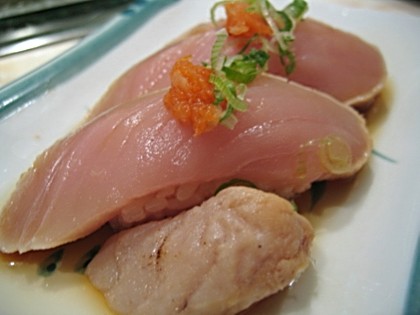
alba (hard) core
As much as I do not favor accessories like sauces, seasonings, and extravagant garnishes on sushi, preferring to actually taste the fish, I very rarely go without spicy tuna in some form or another. I have to admit that there was a time when I even tried to refrain from ordering spicy tuna when I realized that 1) the tuna was the leftover, un-serveable bits of fish, and 2) restaurants were spicing the tuna with Hot Cock. How could they blaspheme the purity of my Japanese fish with a Vietnamese sauce?!?! I refrained for about a week before the Korean in me could hardly take it. I needed the spice.
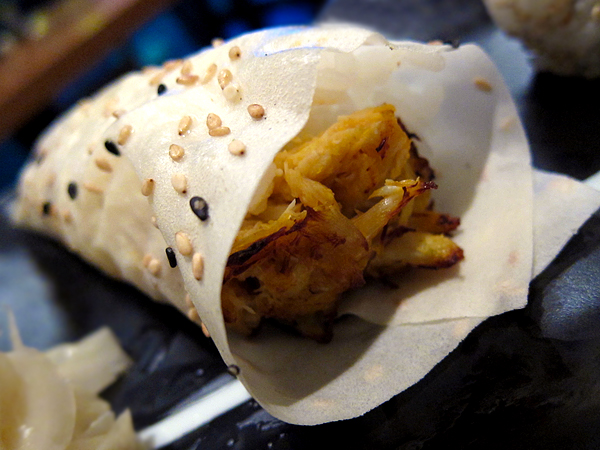
Hakata wraps the spicy tuna the way I love it wrapped. Nori on the outside encases a thin ribbon of rice surrounding a generous circle of spicy tuna. Aesthetically, rolls made with rice on the outside are more pleasing, particularly when they are flecked with black and tan sesame seeds or adorned with sparkling tobiko, but they are much more difficult to manage when the rolls expand beyond the diameter of a bottle cap. It’s like the difference between delivering a large package that has packing peanuts glued to the outside of the box and a regular box filled with peanuts on the outside.

i like nori on the outside

mackerel mystery
Normally I build in strength of flavor throughout a sushi dinner, starting with mild fish as sashimi, reserving something like spicy tuna for the latter half a sushi dinner so I don’t numb my senses too early on. However, we still had oily fish coming. We asked the chef to do mackerel, which he obliged with thick slices of a grayish ivory fish that tasted nowhere near as mild as it looked. It was some sort of mackerel, but I don’t know what kind.
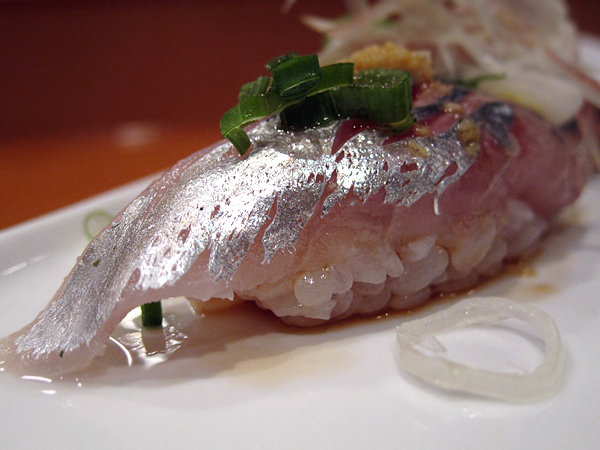
The chef also gave us a second type of mackerel, which he prepared by with the speed and finesse of a pro. He gingerly lifted a tiny corner of skin fron the side of fish, then in one fell swish, peeled off the silvery, outermost skin. He moved his knife-blade in rapid-fire slices first one way, then another, rendering the topmost layer a criss-cut pattern. I don’t know if that was done to physically give the impression of tenderness in the fish’s flesh the way squid is often cut, but I thought it looked interesting. The odd presentation, the silvery gray color, the oiliness and strong fihsiness were delicious to me. I would have had another except that whatever it was, it was MP.
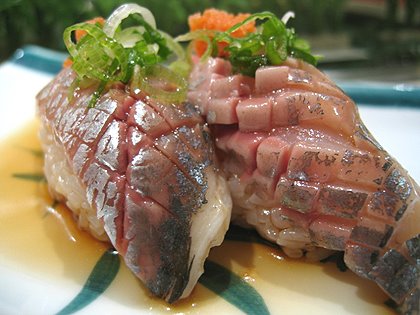
waffle-cut
i surrendered
At the end, I surrendered to a giant unagi and avocado roll covered with spicy tuna, drizzled with the unagi sauce that I usually find too sweet. In such a small dose, however, and with the addition of spicy tuna, I didn't mind it at all.
Hakata reminds me a lot of Hana Sushi, but with much less attitude. I enjoyed the atmosphere and I certainly liked the sushi, though everthing is priced slightly higher than what seems to be competitive in a sushi-saturated area. I liked the sushi. I even liked the monster roll, which, to be quite honest, isn’t even all that crazy by today’s standards. Still, it was a step for me toward hakuna matata.
Have I completely changed mt attitutde toward sushi?
No. I will never understand cream cheese in a sushi roll. Neh. Ver.
Hakata Sushi
2830 Wilshire Blvd (@Yale St)
Santa Monica, CA 90403
310.828.8404
** a year ago today, i had a hunger driven by hormones. wham! bam! thank you, man! **
tags :: food : and drink : japanese : sushi : restaurants : reviews : los angeles
Michael says
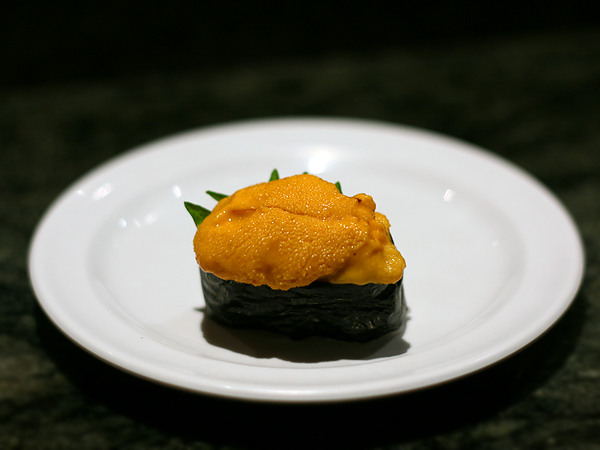
That's an amazing photo! What kind of camera did you use? Can't wait to read the review!
Stephanie says
That is a truly pornagraphic picture! Mustn't let the little one see...he's just too young.
Seriously, that is frakkin' fabulous.
onetomato says
i'm with you on the beauty of perfect nigiri sushi with warm vinegared rice, but there are times for a dragon roll now and then. gasp! oh shame! not everyone can start out eating pure sushi. lord knows i didn't. and with your pretty pics, i don't know if you're promoting "real" sushi or not...
sarah says
michael: thank you. i use nothing special - a small canon sd500 :) no flash, on manual, on the "flower" (macro)
stephanie: ah, but you could develop little alex's exquisite tastes early ;)
onetomato: honestly, for a while, after eating so much "plain" sushi when i was younger, i totally went through a teeny tiny period where i was fascinated by the monster rolls.
but then the sake buzz wore off.
:)
*janet* says
I love your blog. I have to disagree with you on one point, though - Spam Musubi is inexplicably delicious! The real pros grill it so it is toastycrunchy on the outside, and brush a light coat of oyster sauce between the meat and the spam. Yum Yum.
joanh says
yum... the spicy tuna pic is making me want some- but it's 10am here!! will have to try that place next time rather than being lazy and just eating at Hide all the time.
amanda says
mmm mmm mmm... all this sushi looks awesome, and so do your pictures! the only problem is: "hakuna" means "do not have" in swahili, and i don't want to "hakuna hakata"! (double negatives.. i know.) I definately want to "nina Hakata"!
hermz says
that little money cat waving a foam #1 finger... haha!
Umeboshi Superstar says
Wow. I have come full circle in a similar transformation myself. A few years back the only maki I would eat would be nattou or takuan, then I decided to just relax and enjoy myself. Although, no maki will ever dissolve on my tounge like a thick slice of shiro maguro sashimi!
Kirsten Wanket says
Your blog is so very beautiful! Would love your insight as we just launched two new blogs from CA Olive Ranch. Your feedback on the entire blogging experience - from what to do, not to do, improvements - would be greatly beneficial to those starting out to create an online community around all things seasonal as paired with EVOO. Check em out at http://chefs.californiaoliveranch.com and http://consumers.californiaoliveranch.com.
Thanks for any suggestions you have to offer! Warmly, Kirsten
Mari @ Secrets of a Kitchen Wizard says
Beautiful photos! They make me hungry! Sushi restaurants in LA is definitely par to those in Tokyo... I miss them! (I used to live there, but now in SF... not as good, esp when it comes to the variety.) Do you like this one more than those in Torrance, Gardena area, which are frequented by Japanese?
Amaterasu says
I would recommend before eating sushis to have miso soup, try out the extraordinary one which is with melon, link for recipe is: http://www.fourgreensteps.com/community/recipes/soups-a-stews/melon-with-miso-soup. There are other miso soup combination but I would try out the miso soup with melon before any other ones.
John says
Interesting combination. Btw, that site is really cool, other than recipes, there are marketplace with many different products for purchase, community with events, receipes... and infozone with tons of articles and topics for us to read about. Thanks for the amazing site Hoshi!
Ivan says
Agree!!! Thanks Amaterasu!